REST vs GraphQL: Which API Style Fits Your Product?
REST and GraphQL both power reliable products. This guide explains how they differ, where each one works best, and how to choose without following hype.
Key takeaways
- REST exposes resources at separate URLs with fixed responses; GraphQL exposes one endpoint where the client asks for exactly the fields it needs.
- REST is the stronger choice for public APIs, simple data and cases where HTTP caching matters.
- GraphQL is the stronger choice when several client apps need different views of deeply connected data.
- Many products use both: REST for public integrations and GraphQL for their own apps.
Every modern product depends on APIs. They are how your web app talks to your server, how your mobile app loads data, and how other companies integrate with you. Two styles dominate the conversation: REST and GraphQL. Neither is better in general. Each one fits certain products, and choosing well saves a lot of rework.
How REST works
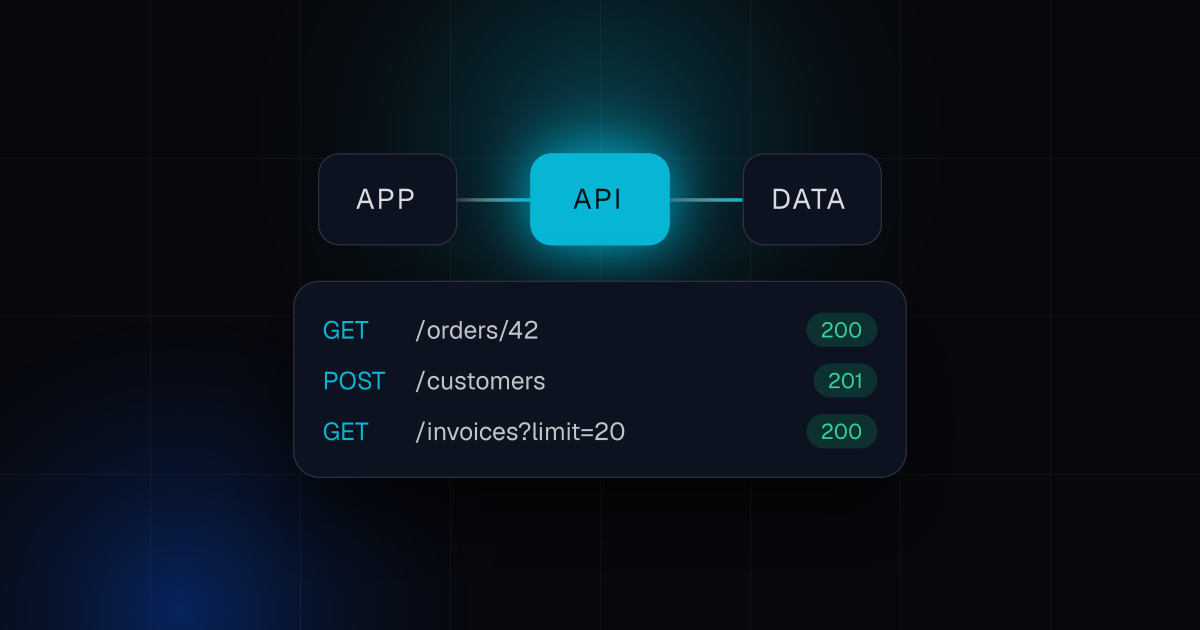
A REST API exposes resources at URLs. You request /orders/42 to get an order and /customers/7 to get a customer, using standard HTTP methods such as GET, POST, PUT and DELETE. Each endpoint returns a fixed structure decided by the server.
REST is simple, widely understood, and works naturally with the infrastructure of the web: caching, status codes, logs and monitoring tools all understand it without extra effort.
How GraphQL works
A GraphQL API exposes a single endpoint and a typed schema. The client sends a query describing exactly which fields it wants, and receives exactly those fields, often from several related resources in one request.
This gives the client a lot of control. A mobile app can request a small payload while an admin dashboard requests a detailed one, both from the same API.
Where REST is the stronger choice
- Public and partner APIs. Most developers know REST, and its conventions make an API easy to learn and document.
- Simple, resource-shaped data. If your API mostly creates, reads, updates and deletes records, REST maps onto it directly.
- Caching matters. HTTP caching works out of the box with REST and takes more effort with GraphQL.
- Small teams and fast starts. There is less tooling to set up and less to learn.
Where GraphQL is the stronger choice
- Several clients with different needs. Web, mobile and partner apps can each fetch exactly what they need.
- Deeply related data. Screens that combine many connected resources can load in one round trip instead of many.
- Rapidly changing front ends. Front-end developers can change what a screen loads without waiting for a new endpoint.
- Strong typing end to end. The schema acts as a contract and enables good tooling and generated types.
The trade-offs people underestimate
GraphQL moves complexity to the server. Flexible queries need protection against expensive requests, careful handling of repeated database lookups, and a deliberate approach to caching and access control on every field.
REST moves complexity to the client. As screens grow, clients may call many endpoints and receive more data than they use, and the number of special-purpose endpoints tends to grow over time.
You do not have to pick only one
Many products run REST for public integrations and webhooks, and GraphQL for their own apps. What matters more than the style is the quality of the API:
- Consistent naming and structure across every endpoint or type.
- Authentication and authorization designed in from the start.
- Input validation and clear error messages.
- Rate limiting and monitoring, so problems are noticed early.
- Documentation that lets someone use the API without asking you.
A concrete example
Imagine a screen that shows a customer's profile, their last five orders and the delivery status of each one.
With REST, the app might first request the customer, then request their orders, then request the delivery status for each order. That can be several round trips, and each response may include fields the screen never displays. The usual fix is to add a special endpoint that returns exactly what this screen needs.
With GraphQL, the app sends one query naming the customer fields, the order fields and the delivery fields it wants, and receives exactly that in a single response. No new endpoint is needed when the screen changes.
Neither is wrong. The REST version is simpler to build, cache and monitor. The GraphQL version is more flexible for the people building the screens. Which matters more depends on how many screens and client apps you have, and how often they change.
Versioning and change
APIs live for years, and they must change without breaking the apps that depend on them.
REST APIs usually handle this with versions, such as a v1 and a v2 of the same API, kept running side by side until older clients have moved over. GraphQL APIs usually evolve in place: new fields are added, and old ones are marked as deprecated and removed once nothing uses them.
Whichever you choose, decide the approach before the first external user arrives. Changing it later is much harder, especially for mobile apps, where some users keep old versions for a long time.
Security applies to both
No API style is secure by default. For either one, make sure that:
- Every request is authenticated, and every piece of data is checked against what that user is allowed to see
- All input is validated on the server, never only in the app
- Requests are rate limited, so one client cannot overload the service
- Errors do not reveal internal details such as database structure
- Sensitive actions are logged, so misuse can be investigated
GraphQL needs one extra safeguard: limits on how deep or expensive a single query can be, because clients are free to compose their own.
A practical recommendation
If you are building a first version, or an API mainly for third parties, start with REST. If you have several client apps showing complex, connected data, GraphQL will likely repay the extra setup. In both cases, a well-designed API is worth far more than a fashionable one.
We design and build both. See our API development and integration services, or get in touch to talk through your product.
- API
- REST
- GraphQL
- backend